
Introduction
In today’s globalized market, manufacturers face unprecedented supply chain pressures, including geopolitical uncertainties, logistics bottlenecks, and production disruptions caused by inconsistent component quality.Many companies rely on traditional manufacturing partners or fragmented supplier networks that lack technical consistency and process transparency, making supply chains fragile and unpredictable.Integrating precision CNC turning technology as a core supply chain strategy can fundamentally strengthen resilience and responsiveness through its unparalleled accuracy, repeatability, and scalability.To understand how this transformation occurs, we need to explore the critical links between precision manufacturing and supply chain management.
What Specific Supply Chain Risks Can Precision CNC Turning Mitigate?
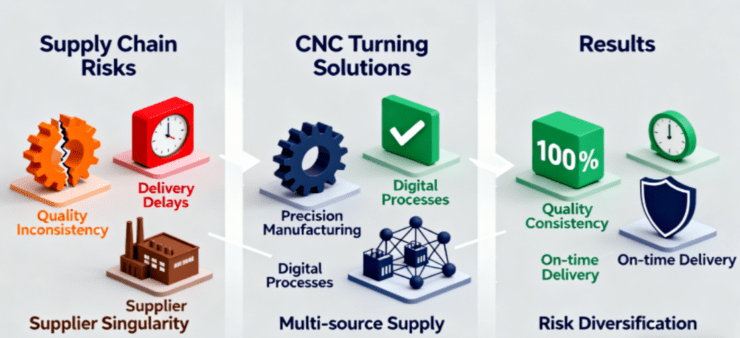
Precision CNC turning directly addresses multiple supply chain risks, thereby enhancing supply chain stability.Firstly, with near-100% repeatability, it eliminates assembly line stoppages and product failures caused by part deviations, resolving quality inconsistency issues.For example, efficient digital production processes and scalable capacity ensure predictable lead times, reducing delay risks.Additionally, providing a technologically reliable, high-capacity backup or primary supply source mitigates supplier singularity problems.According to McKinsey’s report on supply chain resilience, diversifying suppliers and digital manufacturing are key strategies for enhancing robustness(global Industry 4.0 trends report).Precision engineering and manufacturing solutions play a central role here by standardizing processes to reduce uncertainty.
1. Addressing Quality Inconsistencies Through Repeatable Precision
The core advantage of precision CNC turning lies in its repeatability, which directly neutralizes quality fluctuation risks.By automating cutting parameters, each part maintains high consistency, reducing assembly errors and return rates.For instance, in the automotive industry, part deviations can lead to large-scale recalls, but CNC technology ensures tolerances within±0.005mm, boosting overall supply chain stability.
2. Mitigating Delivery Delays with Digital Production Workflows
Digital production workflows, such as ERP system integration, allow real-time progress monitoring and early bottleneck identification.This ensures predictable delivery cycles, avoiding cascading delays.Manufacturing solutions optimize scheduling, shortening traditional lead times from weeks to days, thereby enhancing supply chain responsiveness.
3. Diversifying Supply Sources to Reduce Single-Point Failures
Relying on a single supplier increases vulnerability, whereas precision CNC turning suppliers can serve as backups with technically consistent capacity.For example, Chinese suppliers’scaled production can quickly fill gaps, supporting global sourcing strategies and risk dispersion.
How Does Advanced Quality Control in CNC Turning Directly Translate to Fewer Disruptions?
Advanced quality control is not just an”inspection step”but a supply chain”insurance policy.”Full-process quality systems — from First Article Inspection (FAI) to Statistical Process Control (SPC) — proactively identify and correct potential issues, preventing defective parts from entering logistics.This directly saves rework, return, and downtime costs.For example, systems compliant with IATF 16949 and AS9100D certifications, based on standards like ISO 9001 quality management, ensure rigor for demanding industries such as automotive and aerospace.Quality control and precision engineering transform manufacturing solutions into predictable outputs through preventive measures, reducing disruption frequency.
- The Role of First-Article Inspection in Preventing Defects: First Article Inspection (FAI) comprehensively validates initial samples, ensuring design intent is accurately realized.This step can catch up to 90% of potential issues, avoiding batch defects and maintaining supply chain stability.For example, using coordinate measuring machines (CMM) for dimensional verification eliminates deviations early.
- Statistical Process Control for Proactive Risk Management: Statistical Process Control(SPC)monitors production data in real time, detecting anomaly trends for preventive adjustments.This reduces unexpected stoppages, shifting quality control from reactive detection to proactive management, improving overall efficiency.
- Certification Standards as a Benchmark for Reliability: International certifications like ISO 9001 and IATF 16949 are not just compliance requirements but evidence of a quality culture.They ensure suppliers follow standardized processes, providing credible endorsement for manufacturing solutions and lowering collaboration risks.
Why is Technical Innovation in Manufacturing a Cornerstone for Agile Supply Chains?
Technical innovation, such as automation, IoT sensors, and digital production management, makes supply chains more agile.Real-time production monitoring gives procurement managers unprecedented visibility, enabling better inventory and logistics planning, and shifting from”reactive response”to proactive management.”For instance, China CNC turning suppliers integrating advanced technologies can quickly adapt to demand changes, supporting global sourcing strategies.This innovation not only boosts efficiency but also enhances supply chain adaptability, ensuring stability in volatile markets.
- IoT and Real-Time Data for Enhanced Visibility: IoT sensors collect equipment data, providing production status updates that help managers optimize inventory levels.This transparency reduces guesswork, basing supply chain stability on data-driven decisions.
Automation Reducing Human Error and Boosting Efficiency: Automation
- systems, such as robotic loading, enable 24/7 operation, shortening cycle times and improving consistency.This is crucial for precision engineering, as it minimizes variables from human intervention.
- Digital Twins for Predictive Supply Chain Management: Digital twin technology allows simulation of production scenarios, predicting potential disruptions for preemptive adjustments.Such innovation strengthens the competitiveness of China CNC turningsuppliers, making them key to agile supply chains.
H2. Can Sourcing from a Reliable China CNC Turning Supplier Simplify Global Operations?
Sourcing from a Chinese precision CNC turning supplier offers strategic advantages, including mature industrial ecosystems, cost-effectiveness, and strong capacity.The one-stop servicemodel simplifies multinational procurement complexity by integrating manufacturing, quality control, and logistics management.For example, one-stop CNC machining services provide end-to-end support from design to delivery, reducing communication and management costs.Global sourcing thus becomes more efficient, with China CNC turning services becoming a critical factor in enhancing supply chain stability.
- Leveraging Cost-Effectiveness Without Sacrificing Quality: China’s manufacturing economies of scale allow precision CNC turning suppliers to offer competitive pricing while maintaining quality through certifications.This lowers the total cost of ownership(TCO), supporting long-term supply chain stability.
- Integrated Logistics for Seamless Global Operations: One-stop services include logistics coordination, such as booking shipping space, which compresses delivery times.This integration simplifies cross-border operations, making global sourcing more manageable.
- Case Example:Reducing Hidden Costs through Consolidation: A significant benefit of consolidating production stages with one partner is the reduction of hidden costs from communication, quality fluctuations, and unclear accountability. Industry-leading practice shows this approach can reduce administrative overhead by approximately 20%, directly contributing to greater project stability.
What Makes a Strategic Partnership in Manufacturing More Valuable Than a Transactional Supplier?
Strategic partners differ from transactional suppliers through deep collaboration.Strategic partners engage in early design involvement (DFM) , provide transparent cost analysis, and jointly address sudden challenges, preventing issues and optimizing custom CNC turned parts
production.This relationship, based on trust and long-term goals rather than short-term transactions, ensures supply chain stability during crises. Strategic partnership translates into higher overall value through shared risks and benefits.
Early Design Involvement to Prevent Costly Changes
Through DFM feedback, partners can optimize parts at the design stage, avoiding late modifications. This can save up to 30% in costs and enhance supply chain stability by reducing production delays.
Transparent Communication for Risk Mitigation
Regular progress updates and joint problem-solving quickly resolve crises.For example, shared production data allows clients to adjust plans in real time, strengthening collaboration.
Long-Term Alignment Driving Continuous Improvement
Strategic partners focus on mutual growth, optimizing processes through feedback loops. This relationship transcends transactions, building a resilient supply network.
How Can Manufacturers Identify a Precision CNC Turning Partner for Long-Term Stability?
Manufacturers can select partners using a concrete evaluation checklist to ensure long-term supply chain stability. The list should include: technical capabilities and certifications (e.g., ISO 9001, IATF 16949, and AS9100D as hard indicators), communication and project management (e.g., clear, timely CNC turning quotes and production updates), and scalability and flexibility (ability to handle prototyping and mass production). For example, industry-leading suppliers typically possess these traits, and their technical prowess is often demonstrated through efficient instant quoting systems. Choosing a partner that meets these criteria maximizes project success.
- Evaluating Technical Capabilities and Certifications: Verifying certifications like IATF 16949ensures suppliers meet industry standards. This provides a reliable foundation for precision engineering, reducing quality risks.
- Assessing Communication and Project Management Tools: Suppliers should offer real-time order tracking, such as ERP portals, to maintain transparency.Effective communication is a pillar of supply chain stability, preventing misunderstandings.
- Ensuring Scalability for Future Growth: Partners must handle orders from prototyping to mass production, avoiding capacity constraints.Flexibility enables quick market response, cementing long-term cooperation.
Conclusion
Against the backdrop of the new normal of uncertainty, supply chain stability is a core competitiveness driver, not a cost center. Precision CNC turning provides a certainty foundation for global manufacturers through technical accuracy, quality systems, and partnerships.
FAQs
Q: How quickly can I expect a quote for custom CNC turned parts?
A: A responsive and professional supplier should typically provide a detailed CNC turning quotewithin 1-2 business days upon receiving all necessary technical drawings and requirements.
Q: What is the biggest advantage of using CNC turning over other methods for high-volume production?
A: The key advantage is its unparalleled repeatability and consistency, which is fundamental to supply chain stability.Once a part program is perfected, every subsequent part will be identical, virtually eliminating quality-related disruptions.
Q: How do international certifications like IATF 16949 benefit a manufacturer outside the automotive industry?
A: These certifications represent a verifiable commitment to a world-class quality controlsystem.Any industry that values reliability and risk reduction (from medical to industrial equipment) benefits from this rigorous approach to process control and continuous improvement.
Q: Is it feasible to order both prototype and mass-production quantities from the same precision CNC turning company?
A: Absolutely.This is a hallmark of a flexible and strategic partner.It simplifies the supply chain by allowing for seamless scaling from prototyping and testing to full-scale production, all under one quality control system.
Q: What information is crucial for ensuring an accurate CNC turning project?
A: To ensure accuracy and a smooth process, provide a detailed CAD drawing with tolerances, specify the material and grade, define surface finish requirements, and state your target volumes.This allows the supplier to provide a precise CNC turning quote and manufacturability feedback.
Author Bio
This article was contributed by LS Manufacturing, which helps automotive, aerospace, and medical device manufacturers overcome production volatility challenges caused by inconsistent precision component supply. As an ISO 9001, IATF 16949, and AS9100D certified partner, they guarantee first-pass yield rates≥99.8% and on-time delivery rates≥98%. Submit your project requirements now to claim a complimentary supply chain resilience assessment report.