
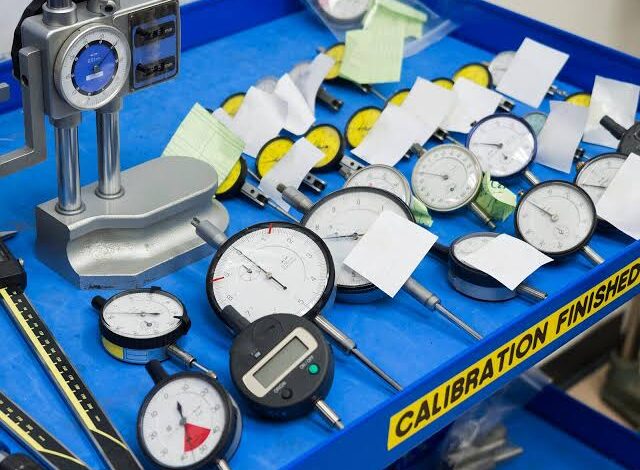
The dial gauge (or dial indicator) is a fundamental instrument in mechanical inspection, used to measure small linear distances, runout, concentricity, and parallelism. Its utility lies in its high resolution and repeatability, allowing inspectors to easily see small deviations. However, the accuracy of the reading is entirely dependent on meticulous dial gauge calibration. Because dial gauges are mechanical devices with numerous moving parts, they are highly susceptible to wear, friction, and stickiness, which directly translate into mechanical measurement error.
The Mechanism of Mechanical Error
Dial gauges work by translating the linear movement of a spindle into the rotational movement of a pointer via a precision gear train. Errors arise from several sources:
- Non-Linearity: Wear and backlash in the gear train cause the gauge to read accurately at the zero point but deviate as the spindle moves through its full travel range.
- Hysteresis/Friction: Internal friction in the gear system causes the gauge to read differently depending on the direction of travel (in-stroke vs. out-stroke), known as hysteresis. This is a common form of mechanical error that is often only revealed during calibration.
- Zero-Setting Error: Misalignment or damage to the contact point can introduce a bias error in the initial zero setting.
The Technical Procedure for Dial Gauge Calibration
Dial gauge calibration is a detailed dimensional process performed using a master gauge block comparator or a specialized calibration tester.
- Zero Verification: The gauge is set to zero against a known master height.
- Linearity Check: The gauge is moved through its entire measuring range (e.g., every 0.1 mm or 0.001 inch of travel) using traceable master gauge blocks or an internal precision screw. The deviation from the true length is recorded at each point.
- Hysteresis Check: The linearity test is performed in both the ascending and descending directions of the spindle travel to quantify the friction/backlash error.
Interpreting Hysteresis and Total Indicator Reading (TIR)
The hysteresis check is critical because friction within the delicate gear train is the biggest limiting factor of a dial gauge’s accuracy. A high hysteresis value indicates the gear train is sticking, causing the pointer to lag the true position of the spindle. The calibration report must clearly define the Total Indicator Reading (TIR) error—the maximum difference between the measured value and the true value across the entire range of travel—which is the ultimate measure of the gauge’s suitability for precision work. If the TIR exceeds the allowable tolerance, the gauge must be repaired or replaced. For digital indicators, calibration also includes verifying the electronic encoder linearity in addition to mechanical movement.
Addressing Wear and Maintenance
Regular use in manufacturing environments exposes dial gauges to contaminants, shock, and repeated cycling, accelerating mechanical wear. If friction and hysteresis errors are too high, the gauge may require cleaning, lubrication, or component repair before it can be calibrated. A full-service metrology provider offers integrated repair and calibration. SIMCO technicians are trained to identify mechanical faults, perform necessary cleaning and repair, and then proceed with accredited dial gauge calibration, ensuring both functional reliability and metrological accuracy.
Traceability and Documentation
All calibration procedures must be traceable and certified to maintain QMS compliance. The calibration certificate must clearly report the errors found at multiple points across the gauge’s range, allowing the user to understand the extent of the non-linearity. Utilizing a reputable provider ensures the integrity of the data. SIMCO’s accredited services provide the necessary detailed documentation, giving mechanical inspectors confidence that their dimensional measurements are traceable and that mechanical errors have been quantified and minimized. For initiating service requests for hand tools, clients can often access specialized service information via SIMCO’s calibration levels page.