
Introduction
The rise of generative AI has presented a paradoxical challenge to writers: while we can now produce text faster than ever, we face the risk of sounding exactly like everyone else. The digital landscape is becoming increasingly homogenized, filled with content that is technically correct but utterly devoid of personality, warmth, and originality. This is what we call the “AI smell”—that faint but noticeable sterile quality that signals a lack of human engagement.
For professional writers, students, and businesses, avoiding this AI scent is critical. Authenticity is the currency of trust online. If your audience suspects your words are merely algorithmically generated filler, they will click away.
This article outlines six fundamental strategies for injecting genuine human flavor back into your writing, transforming robotic prose into compelling, engaging communication. Crucially, we will also discuss the essential tools, like MyDetector AI, that help you diagnose and cure the machine-like tendencies in your drafts, particularly leveraging the power of an AI Content Humanizer.
Pillar 1: Embrace the Power of Variance
AI models are trained to follow statistical probability, resulting in sentences of remarkably uniform length and structure. This uniformity is highly predictable and one of the primary indicators of machine-written text. Human writing, however, is naturally chaotic.
To defeat this structural monotony, you must actively inject “burstiness” into your work. Think of your sentences as musical notes: you need staccato and legato, short bursts and long, flowing phrases.
- Mix it Up: Follow a long, explanatory sentence with a short, punchy declarative one.
- AI Example: “The economic situation necessitated a reassessment of resource allocation, leading to significant changes in departmental budgets and operational procedures.”
- Human Revision: “The economy tanked, forcing us to rethink everything. That meant drastic, painful budget cuts.”
- Vary Openings: Avoid starting every sentence with the subject followed immediately by the verb. Begin with an adverb, a dependent clause, or a prepositional phrase.
Pillar 2: The Specificity Principle
AI often struggles with granular detail because it prioritizes general, widely applicable information. To sound human, you must anchor your writing in specific, tangible reality. Humans write about things they have experienced, not just ideas.
Use the specific over the abstract. Mention names, dates, colors, sounds, and personal anecdotes.
- Avoid Vague Adjectives: Instead of saying “The park was beautiful,” describe it: “The old oak trees smelled of damp earth and sunlight, their leaves the color of oxidized copper.”
- Inject Personal Experience: If you use AI to draft a general point, immediately follow it with a sentence starting with “In my experience…” or “I remember when…” This grounds the abstract idea in your unique perspective.
Pillar 3: The Imperfection of Voice
The machine strives for technical perfection, often resulting in overly formal language that sounds stiff. Humans use contractions, slang, and cultural idioms constantly. These are the small linguistic imperfections that give writing personality.
- Contractions: Use them! “It is” becomes “It’s.” “Do not” becomes “Don’t.” This simple trick immediately makes text feel conversational.
- Idioms: Use phrases unique to a culture or context. Phrases like “let’s cut to the chase,” “it’s a marathon, not a sprint,” or “the elephant in the room” signal a native human fluency that AI often hesitates to use for fear of misinterpretation.
Pillar 4: Mastering the Meta-Check with the AI Detector
Even when you follow all the rules, it can be hard to objectively assess your own writing for that “AI smell.” This is why external verification is essential. You need a tool that can analyze your text with the same rigor used by platforms and institutions.
Before you publish any piece, run it through an AI Detector like those available on MyDetector AI. This tool will give you an objective score based on its analysis of perplexity and burstiness.
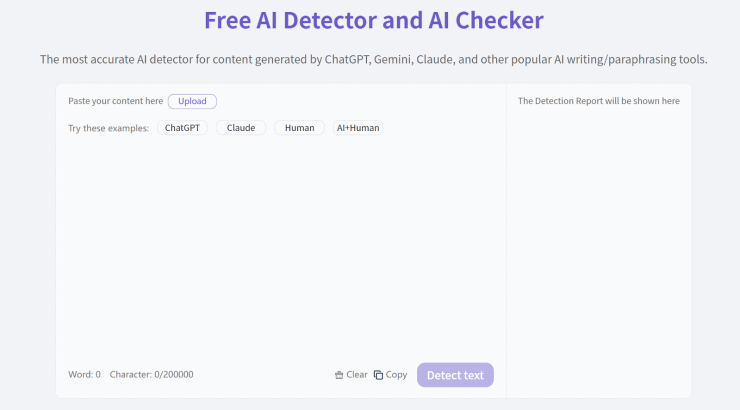
If your score flags your writing as having a high probability of AI origin, do not panic. This is not a failure; it is a diagnosis. It simply means you need to increase the human intervention in the flagged paragraphs. The detector acts as your quality control mechanism, showing you exactly where your writing became too predictable.
Pillar 5: The Humanizer’s Transformation
Once your AI Detector identifies passages that are too robotic, the next step is not manual rewriting—unless you prefer it—but leveraging a targeted solution. This is the role of the AI Content Humanizer.
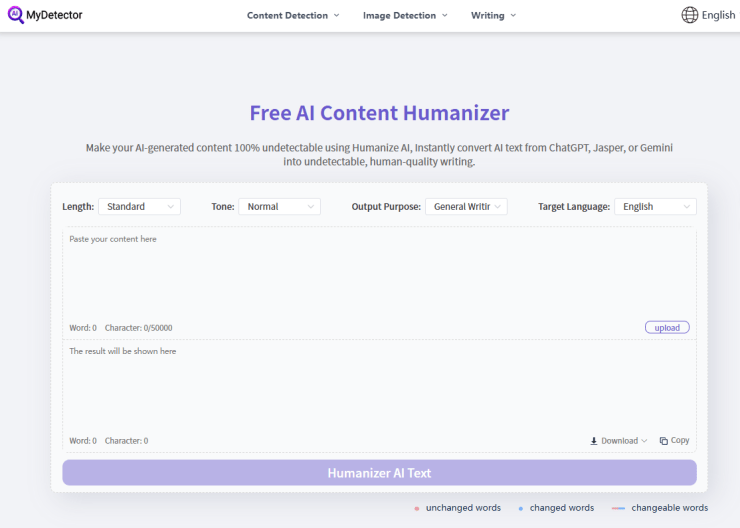
This specialized feature takes the stiff, repetitive output and actively re-engineers it to sound natural. It is programmed to introduce the very elements that AI often neglects: emotional tone, varied syntax, and conversational flow.
- Targeted Use: Instead of running your whole article through, identify the stiffest sections (often introductions or technical summaries) and put them through the AI Content Humanizer.
- Review and Own: The humanized output will be dramatically better, but your final step must be to read it and incorporate your own specific terminology or unique flair. The Humanizer provides the framework, but the final polish belongs to you.
Pillar 6: Argumentation and Flawed Logic
AI, by design, tries to be balanced and comprehensive, often summarizing multiple perspectives without committing to a strong, singular thesis. Human writing is defined by commitment and passion.
- Take a Stand: Don’t just present facts; argue them. Introduce elements of controversy, skepticism, or strong personal belief. AI rarely uses strong words like “ludicrous,” “essential,” or “unquestionably false.”
- Embrace the Rhetorical Question: Pose questions to your reader, and then immediately answer them. This mimics the flow of human conversation and thought, drawing the reader into a dialogue.
Conclusion
The fear that AI will standardize all writing is real, but it is manageable. The key is to view AI not as a ghostwriter, but as a rapid research and drafting assistant. Your true job is the final edit, the personal infusion of character that only a human can provide. By embracing variance, specificity, and personalized language, and by using the diagnostic power of the AI Detector and the stylistic transformation of the AI Content Humanizer, you ensure that your words don’t just convey information—they tell a story that is uniquely yours.